One of our group members was able to find a garage which gave us authority to take some stills of a 'written off' car as well as a dented and damaged car. The stills that were taken we have put as a project with a voice-over over the stills.
Monday, 15 November 2010

Sunday, 14 November 2010
Chosen Poster for ancillary task:
We chose this poster design for our ancillary task because we felt it would be most effective in creating the sense of enigma we were trying to create. As well as this it gives an atmosphere in which makes the audience ask questions and feel compelled to watch the short film.
Thursday, 14 October 2010
Christopher Booker's seven basic plots:
Overcoming the Monster A terrifying, all-powerful, life-threatening monster whom the hero must confront in a fight to the death. An example of this plot is seen in Beowulf, Jack and the Beanstalk, and Dracula.
Rags to Riches Someone who has seemed to the world quite commonplace is shown to have been hiding a second, more exceptional self within. Think the ugly duckling, Jane Eyre and Clark Kent.
The Quest From the moment the hero learns of the priceless goal, he sets out on a hazardous journey to reach it. Examples are seen in The Odyssey, The Aeneid, The Count of Monte Cristo, and Raiders of the Lost Ark.
Voyage and Return The hero or heroine and a few companions travel out of the familiar surroundings into another world completely cut off from the first. While it is at first marvellous, there is a sense of increasing peril. After a dramatic escape, they return to the familiar world where they began. Alice in Wonderland and The Time Machine are obvious examples; but Brides head Revisited and Gone with the Wind also embody this basic plot line.
Comedy Following a general chaos of misunderstanding, the characters tie themselves and each other into a knot that seems almost unbearable; however, to universal relief, everyone and everything gets sorted out, bringing about the happy ending. Shakespeare’s comedies come to mind, as do Jane Austen’s perfect novels.
Tragedy A character through some flaw or lack of self-understanding is increasingly drawn into a fatal course of action which leads inexorably to disaster. King Lear, Madame Bovary, The Picture of Dorian Gray, Bonnie and Clyde—all flagrantly tragic.
Rebirth There is a mounting sense of threat as a dark force approaches the hero until it emerges completely, holding the hero in its deadly grip. Only after a time, when it seems that the dark force has triumphed, does the reversal take place. The hero is redeemed, usually through the life-giving power of love. Many fairy tales take this shape; also, works like Silas Marner and It’s a Wonderful Life.
The basic plot lines help to give a over view on all stories. Our initial idea 1 could be perceived as a tragedy because he gets broken down by commercialism and the character's paranoia of subliminal messaging. Yet it could also be perceived as the 'overcoming a monster' for the character could possibly overcome his mental break down caused by his paranoia. The initial idea 2 with the man panicking, this story could follow the basic plot line of possibly 'Rebirth'. The third idea with the sixth sense type of idea would mostly revolve around 'over coming a monster' for the man eventually has to deal with the fact he is dead. The fourth idea with the school being taken hostage mostly revolves around two young stereotypical characters so this idea could reflect the 'voyage and return' idea, for the two characters become friends through the whole crisis yet separate when its over.
Sunday, 10 October 2010
Brief Gantt Chart for planning:
We decided to make an arrangement of our time for all the months up to our deadline, this would help us to organise our time better and meet the deadline promptly.
October - Research (Short Films, Ancillary tasks and Target Audience)
November - Planning
December - Planning (Of Main Task, Review on Review Page and layout)
January - Filming Main Tasks, Taking photos for ancillary tasks
Feburary - Filming Main Tasks, Taking photos for ancillary tasks (Gives us time to film stuff we may of missed out)
March - Editing
April - Editing
May - Evaluation
October - Research (Short Films, Ancillary tasks and Target Audience)
November - Planning
December - Planning (Of Main Task, Review on Review Page and layout)
January - Filming Main Tasks, Taking photos for ancillary tasks
Feburary - Filming Main Tasks, Taking photos for ancillary tasks (Gives us time to film stuff we may of missed out)
March - Editing
April - Editing
May - Evaluation
Thursday, 7 October 2010
Audience Research: Group Interview- Initial Ideas
We asked a variety of students in Countesthorpe college and here is there response for the piece:
This has helped us to plan which film we will focus our filming on due to what our audience would like to see on screen.
Wednesday, 6 October 2010
initial Ideas:
This piece explains our main ideas for what we plan to produce for our media project:
Basic Plot lines:
Idea 1 (subliminal messaging idea):
Unknown character being followed - based on the mind of an individual. Commercialism all around in his society. The man becomes more and more broken down by subliminal signs.
Idea 2 (panic idea):
Starts with a point of view shot of a person - assumable on the floor. Shots are very blurred and seems quite nauseous. (Twist at the end it becomes apparent to an audience that he is just a passer by. There will be panic around him with emergency sound effects and distortion.
Idea 3 (sixth sense idea):
Camera's following a male character (who is dead, yet the audience do not know as well as the male character). We will notice that he's going on 'normal' trips to shops and carrying on with his normal routine. At the end he begins to realise he is dead seen from a mirror or something that will reveal this information.
Idea 4 (school hostage idea):
A school has been taken hostage by one of its own pupils. Two completely different stereotypes out live the siege. Yet when it is all over the two stereotypes go back to their own groups and do not talk to one another. This is a message on society suggesting that stereotypes of different groups will not stray from their normalisations.
Thursday, 16 September 2010
Short Film analysis:
The short film I have used here is called 'you know too much' and helps to show us the conventions of a short film:
- starting off with the words 'you know too much' going across the screen which they are a little faded as if they are shining through holes.
- starts off with a long shot over a crop field with an aeroplane going over the field. We find out the time from this shot, suggesting it is going into night.
- tracking shot coming vertically down showing a man sitting in the middle of one of these crop fields on a dusty patch of ground.
- it then cuts to a tracking shot with the man running along a path. With a bird flying along side him. This effectively disturbs the equilibrium of the piece.
- as he is running we see a lot of rubbish like old tyres on the floor.
- it then cuts back to him sitting down. His clothes look as if he homeless; with a very baggy jumper and jeans that look dirty, possibly because of the colour.
- jump cutting to a close up of a spider spinning a web, could be showing how the man is going to become trapped or already is trapped. Leaving a sense of question.
- cutting to the man looking around a deserted wheat field with confusion on his face creating a disturbance in the equilibrium for the audience.
- as the pan moves round we see that the man is standing in the middle of a pathway in the field.
- deterring from this path, he starts to run back through the field; possible comment on society and defiance to follow the set 'norm'?
- as the camera tracks the man from behind, we see a darker man running in from the right of the camera screen.
- cuts back to the man sitting down, this short film could be cutting from past the present tenses; the man has an expression of realisation.
- cuts back to the darker man and man fighting over a bag, with the previous man on the floor. this could suggest a sense of inner struggle.
- the camera then cuts to a tracking shot of him face-on with him slowed down to walking pace with the wind against him.
- cuts to a tracking shot of a tree with the camera moving around it. we as an audience expect the man to be in this tree.
- a leaf soon draws the attention in this tracking shot and it is used as a transition for the camera to go back on to the previous man.
- goes to an over the shoulder shot of the man watching as himself and the darker man fight over the bag. Bringing a sense of unknowing of the bag and the state of mind the man is in.
- goes to close up reaction shot of the man.
- as it zooms back into the fighting two men we see the previous man looking at himself asking for help.
- the darker man loses grip of the bag and, the bag is then thrown towards the camera.
- as the bag becomes a close up it moves into another transition through the natural objects in the camera shot.
- the bag is then caught again by the previous man who threw it with a medium shot of the man.
- the darker man begins to chase him again, and the shot becomes over the shoulder of the previous man.
- looks as if the first few seconds are being repeated from the beginning with the man running alongside a bird with a vertical track.
- then cuts to a close up reaction shot of the man as he begins to slow down.
- cuts to a birds eye view of the man running into tall corn fields, cutting to a close up of the mans face with an expression of worrisomeness.
- as an audience then see why the man is scared, the camera cuts to a close up zoom in of the darker man who has an expression of anger on his face.
- cuts to a pan of the field, then to the horizon eventually panning into grass.
- cutting the leaf we saw earlier which made a transition being carried by the wind along a lake.
- cuts back to a close up of the spider with a view of the sun which has gone further down now, yet more disturbance in wind making the web look less neat than before.
- cuts back to the two men, as we see the darker man fall over from a medium long shot.
- goes to a vertical track of the horizon showing how the sun is going down and it is becoming darker whilst the camera follows the leaf.
- goes to the leaf getting caught in the spiders web, bringing more mystery to the mans entrapment.
- repetition of the man looking around confused with a medium shot pan, except this time he walks along the path.
- cuts back to the spider with the leaf in the web, spider could possibly representing the dark character in this piece of media and the leaf representing the other man.
- cuts back to the man running along the path as well as zooming out as the man is getting further away.
- then cuts to the darker man running, with a pan following his running direction.
- tracks aways from the darker man where we see the previous man hiding behind a tree.
- going into a close up reaction shot of the previous man checking to see whether the darker man has gone.
- cutting to a pan from behind the man moving up from a close up to the back of his feet to a long shot of the man walking in the field.
- goes to a dark screen with the the name of the short film coming up as it did at the beginning.
Credits:
The credits are delivered in a slow vertical tracking shot of the scenery which has been featured in the media piece as well as this the writing of directors, editors and actors do not seem to be fading off, they are wrote in bold letters as if they have been printed into the scenery. Near to the end of piece it zooms out from an electrical pylon to what could be seen as an establishing shot implying that the equilibrium has been restored in the story.
Sound:
At the beginning we hear a slight crackling possible voice as well. As it goes into the visual media piece we get a repetitive music track which is played throughout of the piece. Other instruments are added into this base of sound although this sound is the constant in the background until about half way where it changed then comes back. A slower instrument is used at near to the end when the man is scared, showing through the music this is a part of piece which is more silent and slow.
Analysis of a poster for a short film:
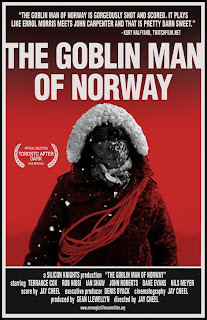
The poster for a short film is a lot like a poster for a normal film. the main difference is the reviews they display on the poster. Usually we would see a number of stars displayed if a film was seen to be a good film by critics. Yet we do not see this on a short film poster we see reviews from a less known company or agency. On this poster design it seems quite simple, due mostly to the possible low budget for advertisement. In the background of the poster, the color red is apparent suggesting a sense of death, as well as the thing that is the focus of attention in this poster. We are immediately drawn to the 'alien' in the picture because of its unusual appearance. The typography is very simple with a white font color
Short film analysis - The suit (Douglas Ray):
- the piece starts with the distribution logo and name.
- a very fast pan to a medium shot of a well dressed man we can assume that the location is set in London because of the scenery.
- cuts to a front on tracking shot of the man talking about his job being a lawyer.
- the building in the background as an audience can assume this is the place that the man is walking towards for work.
- the very fast pan works as a transition so they can smoothly cut to the next shot of the man walking being tracked front on.
- the tracking is then stopped as the man stops walking as he says a firm statement.
- cuts to the man on the tube, where the narrative voice is introduced for the first time in the piece.
- the narrative voice is used basically to describe the mans actions and facial expressions.
- cuts to close up tracking shot of the man as the narrative voice carries on to describe the job.
- cuts to a still shot as the man walks up to camera with an expression of boredom on his face.
- goes to a black screen, as 'the suit' comes up in bold white letters in the middle of the screen.
- cuts back to a tracking shot front on of the man walking, with people in the background of the shot.
- cuts to the man's office and a close up as he whispers to the camera his hate for his job as if the camera is the man's friend. This could suggest that the camera is the view point from someone else's eyes.
- cuts to the man being tracked front on again as he talks about how no-ones hate for their job can compare to his, with a slight smile on his face.
- cuts to a long shot of him sitting at his desk in his office, from what we see, his office is very messy with papers all over the floor and a poster hanging on the wall by the corner of the poster. This could show his further hate towards his job for he does not take much care of his work or office.
- The narrative voice talks over his actions, and from what we can see he looks quite frustrated.
- goes to a medium shot of his hands on the mouse and keyboard of the computer. With more untidiness displayed on his desk.
- goes to a behind shot of the man working on the computer as the narrative voice says 'pretend I'm working'.
- cuts to a close up of the computer screen with 'English Law' wrote on it, suggesting the man doesn't know much about his job.
- cuts to a close up of the mans face which looks confused as he looks at the computer screen.
- it then cuts to a side-on shot of the man and his computer, suggesting that they are on different sides battling one another.
- cuts to a cupboard which is described as a 'forbidden cupboard' giving a sense of mystery about the cupboard.
- as the cupboard is opened, we see the man hiding more of his work load in to this cupboard showing his laziness and lack of work.
- it cuts to a low angle medium shot of the man as the cupboard is closed, the man looks quite confused and shifty.
- cuts to a medium close up of the man standing still telling his depressing story as people in the background are smiling and laughing in the shot.
- cuts to a medium shot of the man holding a 'ready meal' in a supermarket, the camera then pans up to the mans face as he explains.
- cuts to the man being tracked front on once again in the street, with the streets much busier this time.
- cuts to a different scenery and color, the effect could possibly be infer red, as the narrative voice explains the peoples excitement.
- cuts to a zoom in of the man from a medium shot to a close up, showing his upset and depression with people having a good time in the background.
- cuts to a medium shot of the man looking very blankly at nothing, as he looks at his hand, the narrative voice provides a description of his hand.
- cuts to the man in his house in his pajamas looking quite scruffy and suggesting he has just woken up and it is morning.
- cuts to him in the bathroom adjusting his tie.
- we as an audience see the unsteadiness of the camera now, and it becomes clear that a tripod was probably not used.
- goes to a tracking shot from behind with the narrative voice describing his existence's importance.
- cuts to the other side of the room and we see the man coming head on, with his tie adjusted the wrong way, this could be a low comic undertone to his depressive speech, as it follows the man in a pan.
- cuts to the man pressing the button for the elevator.
- it then cuts to the man in the elevator looking quite angry as the narrative voice carries on talking for the man. This could suggest his self esteem has become lower and lower because he begins to speak less and less for himself, yet he says it all through narrative speech.
- cuts to the man standing next to a poster with a man in a suit in the picture. This corresponds with the mans speech as he has just talked about how fake men are who wear suits.
- it then goes to a high angle shot looking down on the man on the escalator.
- as he talks about being a hero and the train stops we see through the window the word 'hero' which was on a poster being the tube.
- it then cuts to the man running into a phone box, this is a reference to superman who changes from a suit to a costume yet he walks out of the phone box retaining his regular wear, because he has no choice than to be a lawyer.
Sound:
In this media piece the main sounds in the film are digetic. We hear a lot of dialogue in this piece, we plan to use very little dialogue if any, because we feel that this lessen the impact of the piece. The main sounds come from the narrative voice that speaks a lot for the man. The other noises come from objects and are digetic for example when he closes the cupboard doors or when he gets on the train. The disadvantage of using mainly dialogue is that it sounds different in different rooms and can echo for example when the man is talking to the camera in the bathroom, the echo has not been dealt with in that room. The main advantage of using dialogue in a piece is the amount of information it reveals about the plot of the storyline.
Credits:
The credits are quite basic, goes to a black screen and the director and actors name come on at the side of the screen. It cuts from the black screen to the man again where he says one last statement, and goes back to the black screen where it says why the film was made. As well as showing at the end the distribution and producing company's name and logo which is of course the BBC.
Subscribe to:
Posts (Atom)